
CMS in 2025

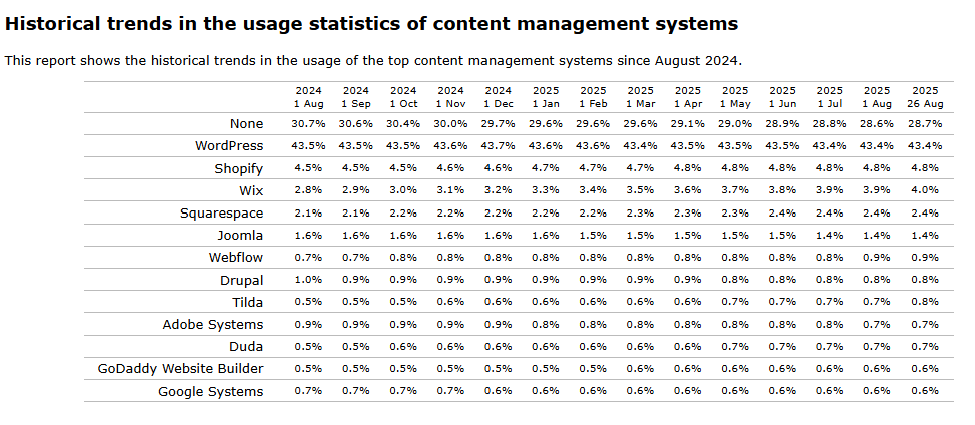
In a world where there are over 1.8 billion websites, with 80 million using a CMS solution. The top contenders for most used CMS solutions are WordPress, Shopify, Wix, and Squarespace. WordPress holds the top spot for the most used CMS solution, with over 40% of websites using WordPress.

According to W3techs.com, the share trends for CMS solutions is as follows:

This report shows the market share trends for the top content management systems since August 2024.
For more information and statistics, see:

Why Big Brands Still Choose WordPress in 2025

In a landscape packed with CMS solutions, WordPress continues to be the go-to choice for major brands around the world. From TechCrunch and BBC America to Sony Music, WordPress remains the preferred platform for its versatility, open-source power, and vast plugin ecosystem.

So why do big brands still trust WordPress?

  1. Scalability—WordPress can power everything from a blog with 10 visitors a day to a global news site with millions.
  2. Customizability—Thousands of themes and plugins allow brands to build completely custom solutions.
  3. The content has strong SEO capabilities—With tools like Yoast SEO and built-in features, it ranks well.
  4. The world boasts a vast talent pool, with thousands of WordPress developers at your disposal.

Moreover, WordPress has invested heavily in modern technology. With the Gutenberg block editor, full-site editing (FSE), and a growing headless CMS ecosystem, it’s more than just a blogging tool; it’s a full web development platform.

And best of all, WordPress is open-source, which means companies aren’t locked into proprietary systems or vendor contracts.

To see some of the websites using WordPress, see the WordPress Showcase: https://wordpress.org/showcase/

Low-Code CMS platforms to consider

The era of low-code and no-code CMS platforms is here and it’s not just for hobbyists anymore. Platforms like Wix, Weebly, and Squarespace are enabling millions of users to build websites without writing a single line of code.

So why are these platforms booming in 2025?

  • Speed: You can go from concept to published site in hours.
  • Affordability: Plans start at under $20/month, with hosting and security included.
  • Design Tools: Built-in templates and visual editors eliminate the need for designers.
  • Mobile Optimization: Most templates are responsive by default.

These platforms work best for portfolios, small businesses, landing pages, and simple e-commerce stores. However, they aren’t ideal for complex functionality or large-scale sites. If you outgrow them, migration to platforms like WordPress can be tricky.

Still, for users who want simplicity, speed, and beauty, no-code CMS platforms are the future.

For more information and to compare different CMS platforms, see: https://www.forbes.com/advisor/business/software/best-website-builders/

Joomla vs. WordPress: Is Joomla a better option?

Joomla was once a major player in the CMS space, rivaling WordPress during the mid-2000s. But in 2025, it’s facing serious competition from newer, more user-friendly platforms like Wix and Squarespace. So, is Joomla still relevant?

The answer is yes, but only for the right user.

Joomla offers a balance between customizability and structure. It features:

  • A robust user access control system
  • Native multilingual support
  • Extensive extension library

Where Joomla shines is in building membership-based platforms, complex directory sites, or nonprofit portals. But its steep learning curve and less active developer community can make it intimidating for beginners.

While Joomla’s market share has shrunk to under 2% globally as of 2025, it still has a loyal user base, especially in government and NGO sectors. Joomla 5’s release focused on speed, accessibility, and improved PHP compatibility.

For more information, reference https://www.hostinger.com/tutorials/joomla-vs-wordpress